ITC at Risk: How to Calculate Exactly How Much GST Credit You're Losing
Learn how to calculate your ITC at risk from missing GSTR-2B invoices, what Section 16(2)(aa) means, and why delayed reconciliation costs you lakhs.
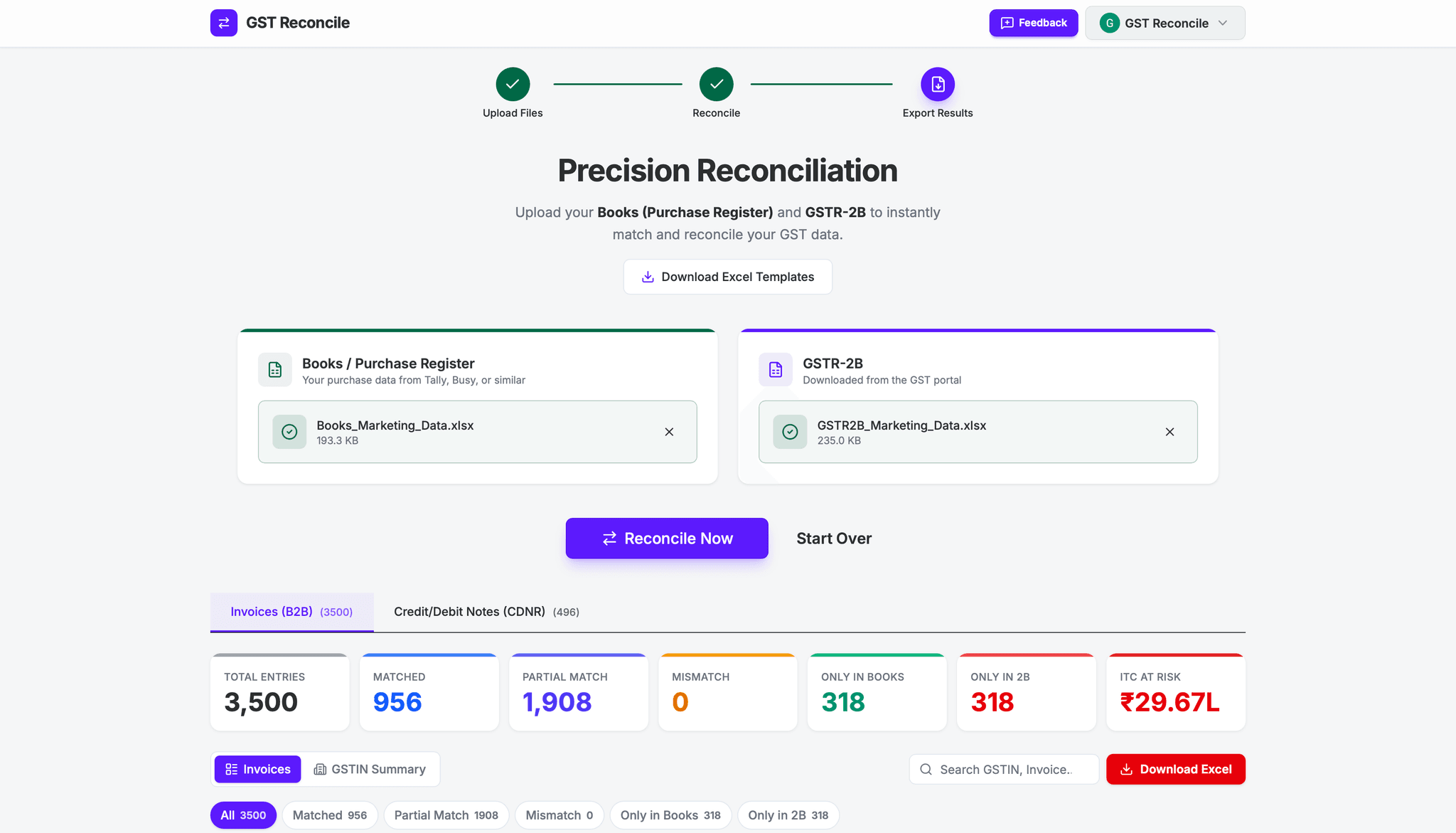
In the world of GST, ignorance is expensive. Many businesses file their monthly GSTR-3B based blindly on their GSTR-2B statement without comparing it to their Books.
By doing this, they completely ignore their ITC at risk. These are the taxes you have paid to your suppliers, but cannot claim back from the government because the supplier failed to report the invoice.
In this post, we will break down the legal meaning of ITC at risk, how to calculate its exact rupee value, and why waiting costs you money.

The Legal Meaning of ITC at Risk
Your right to claim Input Tax Credit is strictly governed by Section 16(2)(aa) of the CGST Act. The law states that ITC can only be availed if the details of the invoice have been furnished by the supplier in their GSTR-1 and communicated to you via your GSTR-2B.
Simply possessing a physical tax invoice is no longer enough. If it is not in the 2B statement, the credit is blocked. The money you paid as tax to the vendor is effectively locked away, acting as a drain on your working capital. This locked amount is your "ITC at risk."
Key point: A physical invoice in your filing cabinet gives you zero ITC rights if it's absent from your GSTR-2B. The law is unambiguous on this.
How to Identify At-Risk Invoices
You cannot calculate your risk without a line-by-line comparison of your data. Run a full reconciliation between your Purchase Register and the GSTR-2B downloaded from the portal.
Once the reconciliation is complete, focus on invoices in the "Only in Books" category. These are entries you recorded (meaning you made the purchase), but the government has no record of — your vendor failed to file.
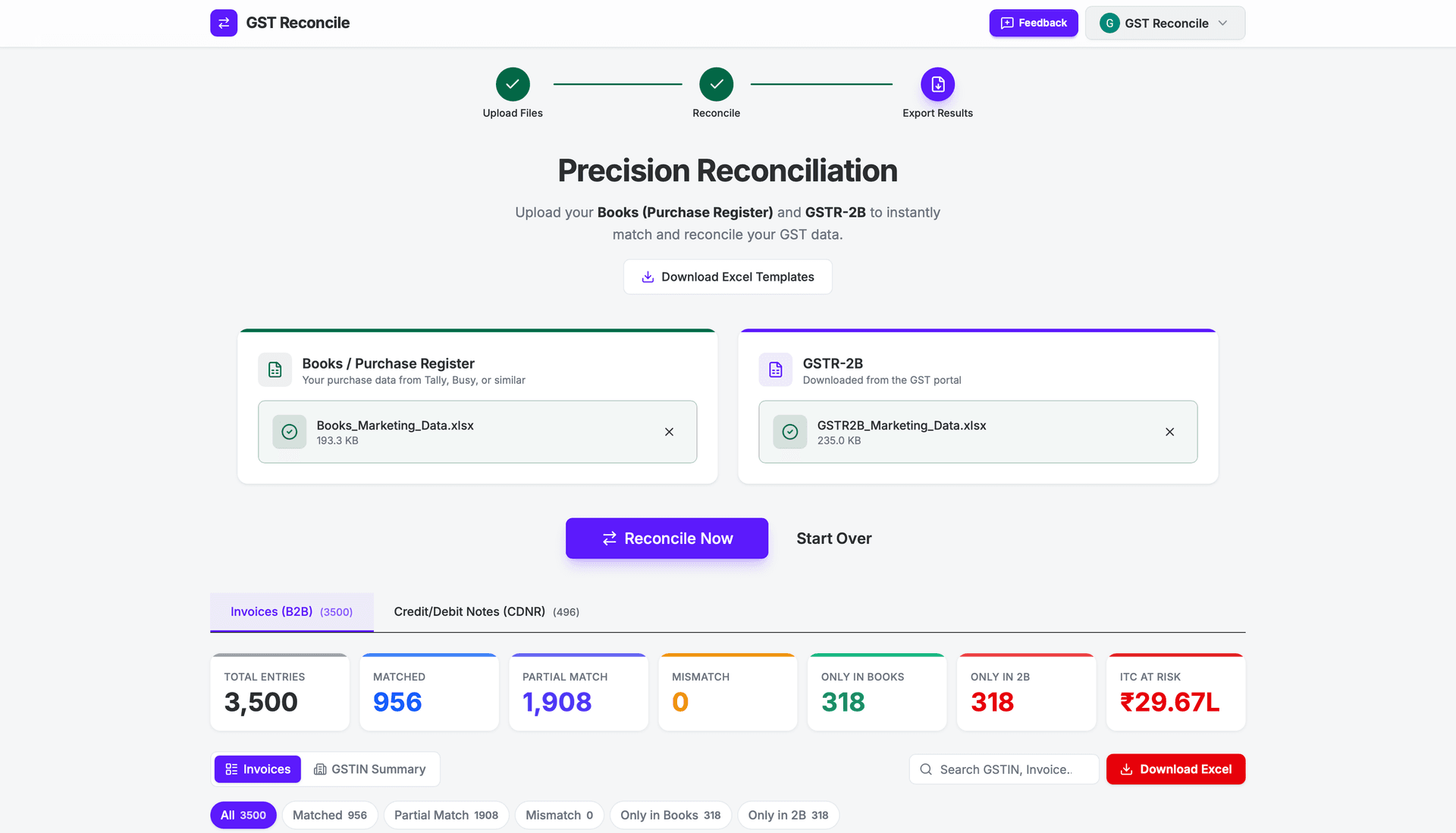
Calculating the Exact Rupee Value
To calculate your total financial exposure, sum up the IGST, CGST, SGST, and CESS components of all invoices categorized as "Only in Books."
In Excel, you would filter your matched sheet by "Only in Books" status and run a SUM on the tax columns. With an automated tool, this figure appears on your dashboard instantly — no filtering required.
A Real-World Example: Lakhs Blocked Every Month
Let's look at a mid-sized manufacturing business processing roughly 5,000 purchase invoices every month.
If the average tax per invoice is just ₹4,000, then 250 missing invoices = ₹10,00,000 (10 Lakhs) of ITC at risk for a single month. That is money you are paying to the government in cash instead of offsetting from the credit you already paid your vendor.
The 20th Deadline: Why Waiting Costs You Money
Time is of the essence. You must calculate your ITC at risk between the 14th (when GSTR-2B is generated) and the 20th (when GSTR-3B is due).
| Action | Deadline | Impact |
|---|---|---|
| GSTR-2B generated | 14th of the month | Your 6-day window begins |
| Identify at-risk items | 15th–16th | Maximum time to chase vendors |
| Chase vendors to file | 17th–18th | Vendors who file by 11th next month |
| GSTR-3B filing | 20th of the month | Pay cash for unclaimed ITC |
If you wait until the 19th to do your reconciliation, it is already too late. You will have to pay the tax in cash and hope the vendor files next month. Delayed reconciliation directly damages your cash flow.
Frequently Asked Questions
Can I claim ITC if it's missing from 2B but I have the physical invoice?
No. Under current GST laws, the physical invoice is irrelevant for ITC claims if the entry does not appear in your auto-generated GSTR-2B statement.
What happens if the vendor files it next month?
If the vendor files late, the invoice will appear in next month's GSTR-2B. You can legally claim the ITC in that subsequent month's GSTR-3B.
Is there an automated way to calculate ITC at risk?
Yes. A reconciliation tool automatically categorizes your 'Only in Books' invoices and instantly displays the total rupee value of your ITC at risk on a summary dashboard.
Stop Leaving Money on the Table
Calculating your exact ITC risk manually in Excel takes hours of tedious filtering and SUM formulas. You can get the exact same result in seconds — and have 5 days left to chase vendors instead of 1.
Reconcile Your GSTR-2B Free
No VLOOKUP gymnastics. No data stored on external servers.
Works with Tally, Busy & ClearTax. Up to 99.99% accurate.
No signup required · ₹450+ Cr ITC Saved · 12.5M+ Invoices Matched